
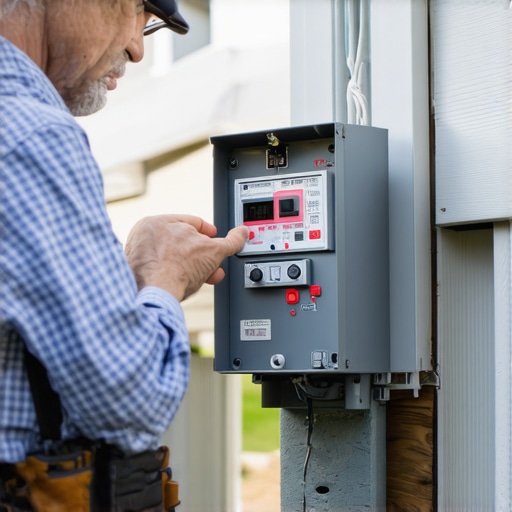
The Invisible Sentinel: Why Your Meter Base is a Ticking Clock
Most homeowners look at their electric meter once a month—usually when they’re grumbling about the utility bill. But as we push into 2026, those gray boxes bolted to the side of your house are no longer just measuring kilowatt-hours; they are structural bottlenecks that were never designed for the load of a modern high-tech home. If your house was built between 1950 and 1980, you’re likely sitting on a piece of aging infrastructure that is physically reaching its metallurgical limit. I’ve spent thirty-five years in the trade, and if there’s one thing I’ve learned, it’s that electricity doesn’t give warnings. It gives autopsies. My old journeyman used to smack my hand if I stripped a wire with a pocket knife. ‘You nick the copper, you create a hot spot,’ he’d scream. He was right. That tiny nick reduces the cross-sectional area of the conductor, increasing resistance, which generates heat. Now, imagine that same principle applied to the massive lugs inside your meter socket, which have been expanding and contracting under the sun’s heat and the load of your HVAC for forty years. That’s where the trouble starts.
Red Flag 1: The Smell of Ozone and the ‘Honey’ Leak
The first sign of a failing meter base isn’t always a flickering light; it’s a scent. If you walk past your service entrance and catch a whiff of something like ozone or burning plastic, you aren’t imagining it. Inside that enclosure, the meter sits in four ‘jaws’ or clips. Over decades, these clips lose their spring tension. In the electrical world, we call this loss of ‘contact pressure.’ When the pressure drops, resistance goes up. The physics are simple: Resistance = Heat. This heat eventually gets so intense that it begins to melt the phenolic blocks that hold the jaws in place. I have opened cans where the plastic has liquefied into a sticky, brown goo that looks like honey. Once that happens, the meter can literally fall out of its seat, causing a massive arc flash.
“Aluminum wire connections can overheat and cause a fire without tripping the circuit breaker.” – CPSC Safety Alert 516
This is especially true in mid-century homes where aluminum lateral service lines were common. Aluminum suffers from ‘Cold Creep’—the metal actually moves and flows away from pressure points over time, loosening the lug and creating a gap where arcs can dance across the gap at thousands of degrees.
Red Flag 2: The ‘Ghost’ Flicker and Neutral Drift
If your lights dim when the microwave kicks on, or worse, if some lights get brighter while others get dimmer, you are witnessing the death of your service neutral. In a standard 120/240V split-phase system, the neutral carries the unbalanced load back to the transformer. When the connection inside the meter base corrodes—often due to water ingress through a cracked service head—the neutral starts to fail. This is what we call a ‘floating neutral.’ Suddenly, your 120V circuits are seeing 160V or 180V, frying your expensive computers, refrigerators, and 2026-era smart appliances. I’ve used my Wiggy (a solenoid voltage tester) to find neutrals that were held together by a single strand of oxidized copper. The homeowners thought they had a ‘ghost’ in the wiring; they actually had a fire hazard that was seconds away from a total phase-to-phase short. If you’re planning an EV charger installation, you absolutely cannot ignore this. Adding a 50-amp continuous load to a compromised meter base is like trying to shove a firehose through a drinking straw.
Red Flag 3: The Green Crust and Enclosure Rot
Look at the bottom of your meter can. Is there a streak of rust or a chalky green residue? That is the hallmark of galvanic corrosion. Water wicks down the service entrance cable like a straw, depositing moisture directly onto the lugs. In many older 60 amp panel upgrades, the installers didn’t use enough ‘monkey shit’ (that’s duct seal for the laypeople) to plug the top of the conduit. This moisture reacts with the different metals—copper, aluminum, and steel—to create an electrolyte. This leads to oxidation layers that act as insulators. You want insulators on the outside of the wire, not at the connection point. When you have an oxidation layer on a lug, the electrons have to ‘jump’ across the crust. This creates micro-arcing. You can’t see it with a tick tracer, but if you put a thermal camera on it, it’ll glow like a Christmas light.
“All electrical equipment shall be installed in a neat and workmanlike manner.” – NEC 110.12
A rotted meter base is a violation of every safety standard we have. If you live in an area prone to storms, flood water electrical safety becomes a major concern; once that enclosure is compromised, any rising water creates a direct path to ground through the surrounding soil, potentially electrifying the ground around your home.
The 2026 Reality: Why a 60 Amp Service Won’t Cut It
We are living in an era of electrification. Between tiny home wiring projects that require high-density power and the push for all-electric HVAC, the old 60-amp or 100-amp service is an endangered species. If you are still running on a small-diameter meter socket, you are likely overloading the bus bars every time the dryer and the AC run simultaneously. This load causes thermal expansion in the conductors. The copper expands, hits the limit of the lug, and when it cools down, it shrinks. After 10,000 cycles of this, the lug is loose. A loose lug is a hot lug. This is why we recommend a meter socket replacement as part of any significant renovation. It’s not about upselling; it’s about ensuring that the trenching electrical conduit and the home run wires coming into your house aren’t being bottlenecked by a piece of rusted tin from the Nixon administration. If you’re doing dock electrical services or installing high-draw outdoor equipment, the meter is the first point of failure. Don’t wait for the fire department to tell you that you needed an upgrade. Grab a flashlight, look for the ‘honey’ leak, and check for the green crust. If you see it, call a professional who knows how to use a torque wrench, not just a pair of dikes and some electrical tape.