
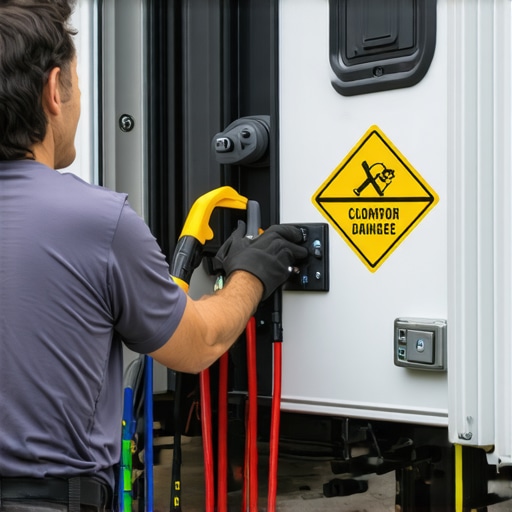
The High-Voltage Nightmare of Modern Travel
You just dropped a quarter-million dollars on a 2026 luxury rig—a rolling fortress of lithium-ion banks, smart glass, and integrated server racks. You pull into your newly minted pad, plug into the pedestal, and thirty seconds later, you smell it. That acrid, metallic stench of burning circuit board components. Your $5,000 inverter-charger just turned into a boat anchor. As a forensic electrical inspector, I’ve spent decades looking at charred remains of ‘easy’ DIY projects, and let me tell you: electricity doesn’t care about your floor plan. It only cares about the path of least resistance. My old journeyman used to smack my hand if I stripped a wire with a knife. ‘You nick the copper, you create a hot spot,’ he’d scream. He was right. That microscopic notch creates a bottleneck for electrons, generating localized heat that eventually crystallizes the insulation. In a high-draw 2026 RV, that tiny nick is a fuse waiting to blow. If you’re building out an ADU electrical services site or a private RV pad, you’re not just installing a plug; you’re building a transformer installation interface that has to be perfect.
1. The Lethal ‘Floating Neutral’ in 50-Amp Service
The most catastrophic failure I see involves the shared neutral in a 120/240-volt 50-amp RV service. Your modern rig expects two balanced 120V legs. If your installer fails to properly torque the neutral lug in the load center upgrades, or uses ‘monkey shit’ (duct seal) as a substitute for proper weatherproofing in the pedestal, that neutral can vibrate loose. This creates a floating neutral. Suddenly, your electronics aren’t seeing 120 volts; they’re seeing a fluctuating voltage that can spike to 240 volts depending on which appliance is running. It will fry every smart controller in the coach instantly. This is why electrical load calculations aren’t a suggestion—they are the law of physics. We’re seeing more 400 amp service entrance installs for properties that host multiple high-end rigs because the draw from these 2026 units, with their multi-zone heat pumps and rapid-charging battery systems, is equivalent to two standard 1970s homes.
“The grounded conductor (neutral) shall be identified and shall be connected to the neutral bar in the service-disconnecting means.” – NFPA 70: National Electrical Code
2. Undersized Feeders and the Physics of Voltage Drop
Voltage drop is the silent killer of sensitive smart lighting installation systems and advanced RV tech. When you run 100 feet of #6 AWG Romex to a pedestal because it was cheaper than #4, you’re asking for trouble. As the load increases, the voltage drops. Your RV’s AC compressors will struggle to start, drawing higher amperage to compensate for the lower voltage, which leads to ‘Cold Creep’ at the terminals. This is the thermal expansion and contraction of the conductor that eventually loosens the connection. I’ve gone in with augmented reality troubleshooting tools to find these hidden heat signatures in walls where the wire was barely glowing before it ignited. If you’re seeing your lights flicker when the microwave kicks on, you’ve got a resistance problem that a 24 hour emergency electrician should have been called for yesterday.
3. The ‘Widow Maker’ Pedestal: Reverse Polarity and Ground Faults
I’ve seen plenty of ‘handyman specials’ where the hot and neutral were swapped. In a house, it might just make a chandelier installation bulb stay live when the switch is off. In an RV, it can lead to ‘hot skin’ syndrome, where the entire metal chassis of your rig becomes electrified. If you’re standing on damp ground and touch the door handle, you become the ground path. This is why I never trust a pedestal until I’ve hit it with my Wiggy or a high-quality Tick Tracer. For any 2026 rig, you should be integrating a permanent surge and polarity protector at the load center upgrades level. Don’t let a $50 mistake at the rough-in stage kill you or your family.
“Aluminum wire connections can overheat and cause a fire without tripping the circuit breaker.” – CPSC Safety Alert 516
4. Neglecting the Grounding Electrode System
People think the ground wire is just a ‘safety’ wire that does nothing. In reality, it’s your only defense against a transient surge. When we do a knob and tube removal in an old garage to prep for an RV hookup, the first thing I look at is the ground rod. If you have high soil resistance or a corroded ground clamp, your rig’s surge protector has nowhere to dump excess voltage. You need a low-impedance path to earth. If your installer didn’t use dikes to clean the ends of the conductors and didn’t apply antioxidant compound to the lugs, you’re just waiting for a storm to brick your coach. Whether it’s a simple smart lighting installation or a massive 400 amp service entrance, if the ground isn’t solid, the system is a time bomb. If you smell ozone or hear a hum from your panel, shut it down and get a pro before your rig becomes a very expensive campfire.