
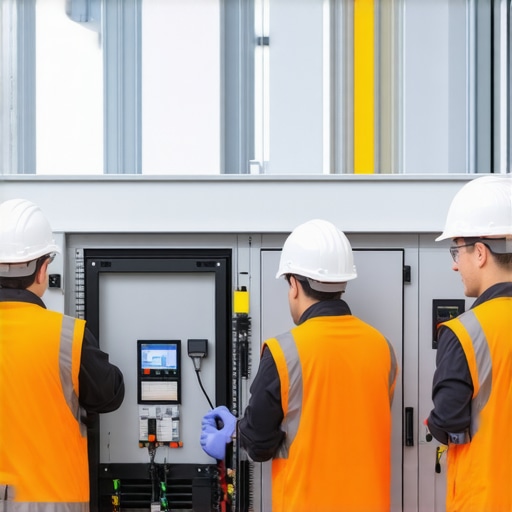
The Anatomy of a Brownout: Why Your Equipment Is Starving
You hear it before you see it. It’s that low-frequency groan from the compressor in your refrigerator or the high-pitched whine of a server power supply trying to stay alive. A voltage sag isn’t just a flicker; it’s a temporary dip in the root-mean-square (RMS) voltage, and in the high-stakes environment of a 2026 data center power setup, it’s a death sentence for sensitive electronics. I’ve spent 35 years tracking down these ghosts, and most people don’t realize that a sag is often more destructive than a total blackout. While a blackout just stops the party, a sag forces your equipment to draw more current to compensate for the lower voltage, overheating internal components until the solder joints literally liquefy.
My journeyman used to smack my hand if I stripped a wire with a knife. ‘You nick the copper, you create a hot spot,’ he’d scream. He was right. Those tiny nicks reduce the cross-sectional area of the conductor, increasing resistance. When you’re dealing with the massive draws required for modern infrastructure, those micro-imperfections become the site of thermal runaway. If you’re seeing sags, your system is likely choking on its own impedance.
“Aluminum wire connections can overheat and cause a fire without tripping the circuit breaker.” – CPSC Safety Alert 516
1. Forensic Bonding Jumper Services: Eliminating the Ground-Neutral Differential
The first place I look during troubleshooting is the service entrance. Most voltage sags in residential and commercial settings aren’t coming from the utility; they’re coming from inside the house. If your bonding jumper services are loose or corroded, you’ve lost your low-impedance path back to the source. I once opened a transformer cabinet where the bonding jumper had been installed with a zinc-plated bolt into a painted surface. The ‘electrician’ didn’t scrape the paint. Under load, that connection was arcing so fast it looked like a strobe light. This creates a floating neutral, which is the fastest way to fry a whole house fan wiring system or a multi-thousand dollar server rack.
You need to verify the integrity of the main bonding jumper. We’re not just looking for ‘tight’; we’re looking for a gas-tight, metallurgical bond. If you have any sign of oxidation—that white, powdery ‘monkey shit’ (duct seal) won’t save you here—you need to disassemble, clean with a stainless brush, and apply a proper conductive grease. Without a solid bond, your system’s reference to ground becomes a moving target, causing the ‘sags’ you see when a heavy motor like a bathroom exhaust fan or a central AC kicks on.
2. Arc Flash Studies and the 60 Amp Panel Upgrade Trap
We are seeing a massive influx of 60 amp panel upgrade requests because people are trying to shoehorn 2026 technology into 1950s infrastructure. If you’re running a solar panel electrical hookup alongside a modern EV charger on an old 60-amp split-bus panel, you are begging for a disaster. These old panels weren’t designed for continuous high-load cycles. They suffer from ‘thermal fatigue,’ where the bus bars expand and contract until the tension in the breaker clips fails. I’ve seen breakers that felt tight but showed 200 degrees on my thermal imager because the internal springs had lost their temper.
“The grounding electrode conductor shall be copper, aluminum, or copper-clad aluminum… and shall be permanent and continuous.” – NEC 250.62
Before you add more load, you need arc flash studies to determine the incident energy levels of your equipment. This isn’t just for industrial plants anymore. If your panel is under-rated, a voltage sag can cause a surge in current that exceeds the interrupting rating of your breakers. This is how you end up needing fire damage wiring restoration. When a breaker fails to trip during a fault because the voltage sagged too low to provide the magnetic force needed for the trip-shuttle, the wire becomes the fuse. It glows, the insulation turns to carbon, and your insurance claim electrical work begins.
3. Harmonic Mitigation in Modern Solar and Data Environments
The third fix involves the ‘invisible’ enemy: harmonics. In a data center power setup, non-linear loads—things that draw power in pulses rather than smooth waves—create harmonic distortion. This ‘reflected’ energy travels back into your system, causing the transformers to hum and the neutral wires to overheat. If you’ve recently performed a solar panel electrical hookup, your inverter might be fighting the grid. Cheap inverters produce ‘dirty’ power that simulates a voltage sag by clipping the peaks of the sine wave.
I use my Wiggy (solenoid voltmeter) and a Tick Tracer to identify basic presence, but for sags, you need a power quality analyzer. We often find that the ‘sag’ is actually a high-frequency transient caused by poor filtering. Fixing this involves installing K-rated transformers or active harmonic filters. This isn’t DIY territory. If you’re poking around in a live panel with a ‘widow maker’ (non-contact voltage tester) and you don’t know the difference between a grounded conductor and a grounding conductor, you’re going to get hit. Electricity doesn’t have a ‘low’ setting; it’s always looking for a path to ground, and your body is 70% salt water—a perfect conductor. Always check your home run circuits and ensure your rough-in was done to code before you blame the utility company for your voltage drops. Check those dikes, torque your lugs, and for the love of everything holy, stop using the ‘stab-in’ holes on the back of your receptacles. [{“@context”: “https://schema.org”, “@type”: “HowTo”, “name”: “Fixing Power Quality Sags”, “step”: [{“@type”: “HowToStep”, “text”: “Perform a load calculation to ensure the current panel capacity (e.g., upgrading a 60 amp panel) can handle modern electronics.”}, {“@type”: “HowToStep”, “text”: “Inspect and tighten all bonding jumpers and grounding electrodes to ensure a low-impedance path.”}, {“@type”: “HowToStep”, “text”: “Install active harmonic filters or K-rated transformers to mitigate non-linear load interference in data centers.”}]}]
This post really hits close to home for me, especially the part about grounding and bonding. In my experience working with older commercial buildings, I’ve seen how overlooked bonding connections can cause persistent sags during peak loads. It’s amazing how something as simple as cleaning and proper greasing can make such a difference in system stability. I also agree on the importance of arc flash studies before upgrading panels—skipping that step can be disastrous, especially with the new high-efficiency loads coming into play. Harmonics, though often silent and invisible, are another tricky issue. I’ve seen data centers upgrade their transformers and add filters after they started experiencing transformer humming and overheating issues, which was caused by high harmonic distortion. It’s crucial that we tune our systems right and don’t just throw new tech in there without proper analysis. Have you or others encountered challenges in balancing harmonic mitigation with cost-effective solutions? Would love to hear about practical approaches that worked well.