
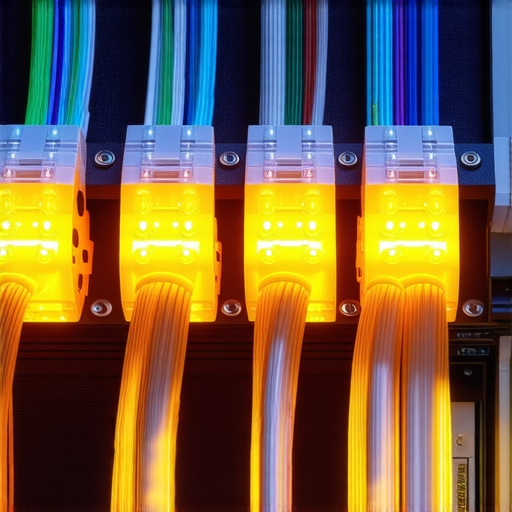
The Ghost in the Glass: Why Your Data is Lagging
I remember my first journeyman, a man who smelled like stale coffee and electrical ozone, screaming at me because I was pulling a piece of 12/2 Romex through a hole with too much aggression. ‘You nick that copper, you create a hot spot,’ he’d bark. ‘Physics doesn’t care about your schedule.’ That lesson stuck. Today, we aren’t just pulling copper; we are pulling glass. If you think your 2026 internet lag is just a ‘provider issue,’ you’re ignoring the physical reality of your home’s infrastructure. Most of you are trying to run a Ferrari engine through a garden hose. You’ve got a modern router connected to phone line installation tech from the Reagan era, and you wonder why your Zoom call looks like a 1990s Japanese horror film.
Electricity and data are cousins, but they don’t play by the same rules. While I’ve spent decades troubleshooting a 400 amp service entrance or diagnosing why industrial motor controls are humming like a disturbed hornet’s nest, the transition to fiber optics brings a whole new set of forensic failures. We are talking about signals moving at the speed of light through a silica core thinner than a human hair. When that glass is compromised by poor installation, signal attenuation—what we call ‘the lag’—becomes inevitable.
1. Replacing the Ancient Copper Backbone
The biggest bottleneck in any residential or light commercial setting is the reliance on legacy copper. If your home still relies on old-school phone line installation for its primary data entry point, you are dead in the water. Copper is susceptible to electromagnetic interference (EMI). When you run a data line parallel to a high-voltage line—say, the one feeding your track lighting services—you get crosstalk. The magnetic field from the AC current induces a voltage on the data line, corrupting the packets. This is why we move to fiber. Fiber optic cables carry light, not electricity. They are immune to the EMI that plagues copper.
“Aluminum wire connections can overheat and cause a fire without tripping the circuit breaker.” – CPSC Safety Alert 516
While that quote refers to power, the principle of ‘material failure’ applies to data. Just as aluminum wiring from the 70s fails due to cold creep, old copper data lines fail due to oxidation and physical degradation of the jacket. Upgrading to a dedicated fiber run from your overhead service drop directly to your central hub is the only way to bypass the ‘noise’ of a mid-century home’s electrical system.
2. The ‘Home Run’ Strategy for Smart Infrastructure
In the trade, we call a direct line from the panel to the device a ‘Home Run.’ Most DIYers try to daisy-chain their tech. If you’re doing smart thermostat wiring, you might think you can just tap into the nearest 24V transformer. Wrong. By 2026, every smart device in your home will be fighting for bandwidth and stable voltage. A fiber-to-the-room upgrade ensures that your high-bandwidth devices—like 4K security monitors or complex PA system installation controllers—aren’t sharing a lane with your smart toaster.
When I perform electrical wiring services, I look for ‘ghost voltage.’ This is induced voltage that lingers on a wire that isn’t even connected to a load. In a data context, this is the equivalent of ‘latency spikes.’ By using fiber for your internal backbone, you eliminate the possibility of these spikes. Use a tick tracer on a standard Cat5e cable near a running microwave, and you’ll see the interference. Try that with a fiber optic cable, and it stays dead silent. That silence is the secret to 2026-grade speeds.
3. External Infrastructure: Beyond the Four Walls
We are seeing a massive surge in people needing high-speed data at the edge of their property. Whether it’s a camper electrical panel at the back of the lot or fence line lighting with integrated cameras, copper is your enemy here. Why? Lightning. Running a copper data line 100 feet across a yard is essentially burying a lightning rod. I’ve seen industrial motor controls fried to a crisp because a strike 200 yards away traveled through a buried data line.
The fix is dielectric fiber optic cabling. Since there is no metal in the cable, there is no path for the surge to travel. You can provide gigabit speeds to your guest house or your camper electrical panel without worrying about a summer storm nuking your entire network. When you’re sealing these conduits, don’t forget the ‘monkey shit’—that’s trade talk for duct seal. It keeps the moisture out of the transitions, preventing the freeze-thaw cycle from snapping your delicate glass fibers.
4. The Power-Data Paradox: 400 Amp Upgrades
You can’t have elite data without elite power. As we move toward 2026, the ‘all-electric’ home is becoming a reality. Between EV chargers and heat pumps, a 100-amp or even 200-amp service is often redlined. I’ve been in basements where the main breaker was so hot you could fry an egg on it. This heat radiates. If your data hub is located near a struggling, undersized electrical panel, the heat will degrade the performance of your routers and switches.
Upgrading to a 400 amp service entrance isn’t just about being able to run the dryer and the AC at the same time; it’s about ‘thermal management.’ A larger service means your breakers run cooler, your voltage stays more stable (preventing the dreaded ‘brownout reboot’ of your router), and you have the physical space to separate your high-voltage feeders from your sensitive fiber optic terminations. It’s about building a fortress for your electronics.
“The technical requirements for grounding and bonding must be strictly followed to ensure the safety of both the electrical system and any connected communications equipment.” – NFPA 70E Standard for Electrical Safety
When I’m out in the field with my Wiggy (a solenoid voltmeter for the uninitiated), I’m looking for solid grounds. If your house isn’t grounded properly, your data equipment becomes the path of least resistance for electrical faults. Fiber solves the ‘isolation’ part of this puzzle, but your hardware still needs a clean power source. If you’re still using a ‘widow maker’ (those cheap non-contact voltage testers) to check your outlets, put it down and call a pro. Your 2026 internet speed depends on the physics of your 1970s wiring more than you think.