
The Hum of Impending Failure
Listen closely to your electrical panel when the AC kicks on and the dryer is mid-cycle. Do you hear that? A faint, rhythmic vibration? That’s not ‘normal’ operation; that’s the sound of molecules in a 100-amp bus bar screaming under the strain of modern life. As a forensic inspector who has spent three decades sniffing out the acrid scent of charred Romex, I can tell you that the 100-amp service—once the gold standard of the American home—is rapidly becoming a fire hazard in the face of 2026 power demands.
My old journeyman, a man whose hands were so scarred from 480-volt ‘bites’ they looked like cured leather, used to smack my knuckles if I didn’t seat a wire perfectly. ‘Electricity is lazy, kid,’ he’d growl while I was doing a rough-in. ‘It’ll take the easiest path, but if you give it a narrow bridge, it’ll burn the bridge down to get across.’ He was right. Today’s ‘narrow bridge’ is your outdated electrical service. We are pushing more current through residential copper than the engineers of the mid-century ever dreamed possible. If you think your service can handle a new EV charger, an induction range, and those heavy-duty commercial electrical services you’re trying to run from a home office, you’re playing a dangerous game of thermal roulette.
“The calculated load of a service shall not be less than the sum of the loads on the branch circuits.” – NEC Article 220.10
The Physics of the ‘Cold Creep’ and Thermal Runaway
Why does a 100-amp panel fail? It’s rarely a sudden explosion. It’s a slow, microscopic suicide. Let’s look at the physics of the terminal lug. When you draw 80 amps through a service rated for 100, the copper expands. When you turn the appliances off, it contracts. In older panels, particularly those with aluminum components or low-grade alloys, we see ‘Cold Creep.’ The metal deforms under the pressure of the screw, eventually creating a microscopic gap. This gap introduces resistance. According to Ohm’s Law, resistance creates heat ($I^2R$). This heat creates an oxidation layer—a thin skin of non-conductive crust—which increases resistance further. This is the thermal runaway. By the time you notice the flickering lights, the interior of your main disconnect services might already be reaching temperatures capable of igniting the surrounding plywood.
The 2026 Power Wall: Why 100 Amps is a Bottleneck
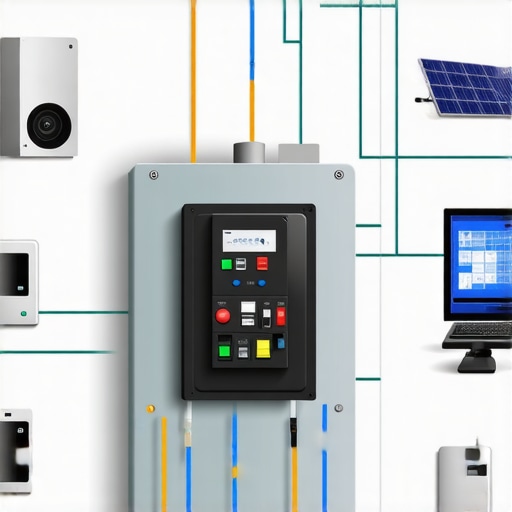
By 2026, the average household won’t just be powering lightbulbs and a toaster. We are looking at the ‘Electrification of Everything.’ An EV Level 2 charger pulls 40 to 50 amps. A modern heat pump can pull another 30. Throw in a smoke detector installation that’s tied into a whole-home hub and a PA system installation for your media room, and you’ve exceeded your 80% continuous load limit before you’ve even turned on the microwave. We are seeing homeowners request RV hookup installation for their campers, not realizing that plugging in a 30-amp travel trailer is the literal straw that breaks the camel’s back. [image_placeholder_1]
Forensic Evidence: What Thermal Imaging Reveals
When I perform thermal imaging inspections, I’m not looking for ghosts; I’m looking for the ‘White Heat.’ In a 100-amp panel under heavy load, I often see the main breaker glowing white on the FLIR camera. This indicates a ‘Hot Spot’ where the breaker clips onto the bus bar. If you’re lucky, the breaker trips. If you’re unlucky—especially if you have an old Federal Pacific or Zinsco ‘widow maker’ panel—the breaker jams. It stays closed while the bus bar melts into a puddle of slag. This is why electrical load calculations are not optional suggestions; they are the blueprint for your survival.
“Aluminum wire connections can overheat and cause a fire without tripping the circuit breaker.” – CPSC Safety Alert 516
The Commercial Shift in Residential Spaces
We are also seeing a blurring of lines. More people are running high-demand equipment at home, necessitating arc flash studies that were once reserved for industrial plants. If you are running a server farm or high-end woodworking equipment, a 100-amp service is a joke. You need a ‘Heavy-Up’ to 200 or 400 amps. During the trim-out phase of a modern renovation, the sheer volume of home run cables coming back to a 100-amp panel creates a ‘crowded gutter’ situation. The heat can’t escape. The wires cook each other in the wall.
The Weekend Electrician Trap
I’ve seen it a thousand times: the ‘handyman’ who offers weekend electrician services and adds a sub-panel for a hot tub without checking the main service capacity. He uses a tick tracer to see if it’s hot, slaps in some monkey shit (duct seal) to plug the hole in the wall, and walks away with your cash. He hasn’t calculated the demand factor. He hasn’t checked the main disconnect services to see if the lugs are torqued to inch-pounds. He’s left you with a ticking time bomb. This is especially true for holiday light installation. People think LEDs are ‘cool,’ but when you string 5,000 of them together with cheap extension cords, you’re creating a massive inductive load that can destabilize a weak main service.
The Verdict: Upgrade or Risk the Arcing
If your home was built before 1990 and you haven’t upgraded your service, you are likely living on borrowed time. The solution isn’t just a bigger breaker; it’s a systematic overhaul. This includes a new weather head, a larger service mast, and a panel that can handle the 2026 reality. Don’t wait for the smell of ozone. Don’t wait for your Wiggy to tell you the voltage is sagging. Get a professional load calculation. Torque your lugs. Sleep at night knowing your house isn’t trying to burn you alive from the inside out.