
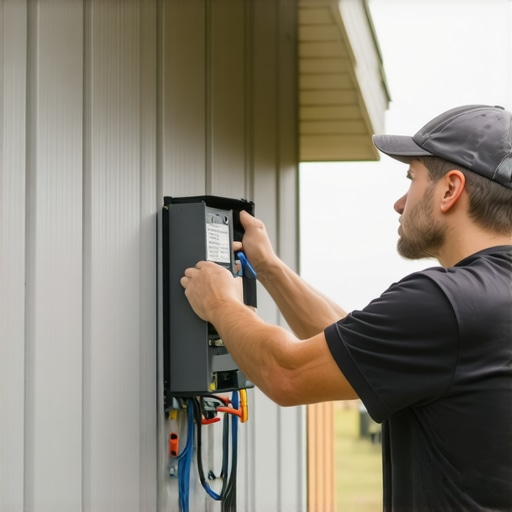
The Anatomy of a Failed Inspection: Why Your Shed Wiring is a Liability
I’ve spent 35 years pulling wire through places spiders wouldn’t touch, and if there is one thing that makes me reach for my Wiggy in frustration, it is the ‘DIY Shed Special.’ People treat a backyard shed like a hobby project, but electricity doesn’t care about your hobbies. It only cares about the path of least resistance. When you run a home run from your main panel to a secondary structure, you aren’t just adding a lightbulb; you are extending your home’s electrical footprint into an environment that wants to destroy it. I’ve walked onto properties where the owner was proud of his ‘renovated’ workshop, only to find the shed’s metal siding was literally electrified—a ‘hot skin’ condition—because he’d used a bootleg ground and the neutral had floated. One touch with a bare hand on a rainy day, and that shed becomes a coffin.
My old journeyman, a grizzly guy named Miller who could bend 1-inch EMT with his teeth, used to tell me, ‘Kid, if you don’t respect the burial depth, the earth will spit your mistakes back at you.’ He was right. Most homeowners think throwing some Romex inside a piece of garden hose and burying it four inches deep is ‘good enough.’ It’s not. As we move into the 2026 inspection cycles, the National Electrical Code (NEC) and local inspectors are cracking down on these specific secondary structure installs with a level of scrutiny we haven’t seen in decades. If you’re planning a shed wiring install, you need to think like a licensed master electrician, or you’ll be paying for code violation corrections before the paint is even dry.
Mistake 1: The Grave Error of Burial Depth and Conduit Choice
The physics of the earth are relentless. We deal with ‘frost heave’—the mechanical movement of soil as it freezes and thaws. If you bury your conductors at 6 or 12 inches, the soil will eventually grab that conduit and snap it like a twig. Once the conduit shears, the wire is exposed to sharp rocks and hydrostatic pressure. In my forensic inspections, I’ve seen PVC conduit that looked like it had been through a wood chipper because the installer didn’t account for the expansion and contraction of the clay soil. [IMAGE_PLACEHOLDER]
For a 2026-compliant install, you need to understand the difference between Schedule 40 and Schedule 80 PVC. Most people grab the cheap Schedule 40, but if that conduit is emerging from the ground where it’s subject to ‘physical damage’—like a weed whacker or a lawnmower—the code requires Schedule 80. The wall thickness of Schedule 80 is significantly higher, providing the mechanical protection needed to prevent a holiday emergency call when someone accidentally slices through a live 240V line while trimming the hedges. Furthermore, burial depths are non-negotiable. If you aren’t at 18 inches for PVC or 24 inches for direct-burial UF cable, you are failing. I recommend 24 inches regardless. It’s the difference between a system that lasts 50 years and one that shorts out after the first hard freeze.
“Aluminum wire connections can overheat and cause a fire without tripping the circuit breaker.” – CPSC Safety Alert 516
Mistake 2: The Grounding and Bonding Trap
This is where the ‘handymen’ really lose their way. They think they can just run a hot, a neutral, and a ground from the house and call it a day. But a shed is a separate structure. According to NEC 250.32, you must maintain a very specific relationship between your grounding system and your neutral conductor. In the main house, your neutral and ground are bonded together. In the shed? They must be isolated. If you bond them in the shed, you create parallel paths for the neutral current. This means your grounding wire—the one that’s supposed to be a safety path—is now carrying live current under normal conditions. This is a recipe for disaster.
In 2026, inspectors are looking for a dedicated grounding electrode system for the shed. That means driving an 8-foot copper-clad rod into the earth and connecting it to the shed’s sub-panel. I once inspected a shed where the owner had skipped the grounding rod and used the metal skids of the shed as a ‘ground.’ A surge from a nearby lightning strike didn’t go into the earth; it went into his power tools, blowing the triggers out of his drills and nearly catching his workbench on fire. You need a licensed master electrician to verify that your equipotential grid is properly established if you’re doing anything more than a single branch circuit. If your shed is near a pool or a hot tub, the rules get even more surgical. You’re talking about bonding grids that prevent even millivolts of difference between metal surfaces.
Mistake 3: Undersized Conductors and the ‘Voltage Drop’ Nightmare
Resistance is a silent killer. When you run electricity over long distances—say, 100 feet from your 100 amp service upgrade in the garage to a shed at the back of the property—you lose voltage. This is Ohm’s Law in action: V=IR. If your voltage drops too low, your motors (like that table saw or the compressor) will pull more amperage to compensate. More amperage equals more heat. More heat equals the insulation on your wires melting inside the walls where you can’t see it. [IMAGE_PLACEHOLDER]
I’ve seen commercial electrical services have to step in and fix residential ‘pro’ jobs because the installer used 12-gauge wire for a 100-foot run to a shed intended for a workshop. By the time the power got there, the 120V was down to 104V. The owner wondered why his lights flickered every time his fridge kicked on. In 2026, we are seeing tighter requirements for load calculations under NEC Article 220. If you are adding a standby generator install to your property, your shed load has to be factored into that calculation. You can’t just ‘tap’ into a circuit. You need a dedicated home run. If you’re running a sub-panel, you should be looking at 6-gauge or 4-gauge copper to ensure that when you turn on that heater in the winter, the wires aren’t acting like a toaster element inside your conduit.
“Equipment grounding conductors shall be installed with the circuit conductors and connected to the building or structure disconnecting means…” – NEC 250.32(B)
Mistake 4: Missing the Ingress Protection (The ‘Monkey Shit’ Rule)
Water and electricity are the ultimate enemies. I can’t tell you how many times I’ve pulled the cover off a shed panel and had a pint of water pour out onto my boots. Where does it come from? Condensation and improper sealing. When you run conduit from a warm house into a cold ground and then into a shed, that pipe acts like a straw for humid air. The air hits the cold section of the pipe, condenses into water, and gravity carries it straight into your electrical bus bars. This leads to ‘pitting’ on the breakers and eventual arcing.
We use what we call ‘monkey shit’—duct seal—to plug the ends of the conduit. If your permit pulling services didn’t specify the use of NEMA 3R rated enclosures and proper sealing techniques, the inspector will red-tag you in a heartbeat. And don’t get me started on the lack of GFCI (Ground Fault Circuit Interrupter) protection. As of the latest updates, almost every outlet in a shed or accessory building requires GFCI protection. If you are running three phase power services for a heavy-duty home machine shop, the requirements for arc-fault and ground-fault protection become even more complex. You need to ensure every rough-in and trim-out is moisture-resistant. If I see a standard indoor-rated outlet box in a shed, I don’t even need my tick tracer to know I’m looking at a violation. I can smell the impending oxidation from the driveway.
The Forensic Reality: Sleep Better with Code-Compliant Power
Electricity isn’t a hobby. It is a utility that demands respect. If you’re cutting corners on your shed wiring install, you aren’t just risking a ‘fail’ on an inspection; you are risking the structural integrity of your property. I’ve seen sheds that cost $20,000 burn to the ground in fifteen minutes because of a loose neutral lug that was never torqued to spec. Modern codes require torque-limiting screwdrivers for a reason. Metals expand and contract. If that connection isn’t exactly where the manufacturer specifies, it will wiggle loose over time, create an arc, and find a fuel source.
Don’t be the guy who waits for a holiday emergency call to realize his shed is a fire trap. Get a licensed master electrician involved early. Whether you need commercial electrical services for a large outbuilding or just a simple 100 amp service upgrade to handle the extra load, doing it right the first time is the only way to ensure you can sleep at night. When I sign off on a job, I want to know that if a kid leans against that shed or a dog digs near that conduit, they are safe. That’s the standard. Anything less is just waiting for a disaster to happen. Keep your wires deep, your grounds isolated, and your lugs torqued. That’s how you pass 2026, and that’s how you stay alive.