
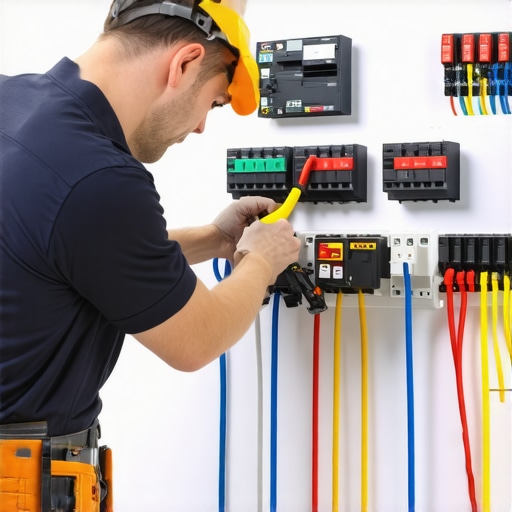
The Invisible Fire: Why Your 1970s Electrical Panel Can’t Survive 2026
I can hear a bad circuit before I see it. It’s a specific frequency—a 60-cycle hum that’s just slightly off-key, punctuated by the occasional ‘tick’ of expanding copper. Most homeowners ignore it. They think it’s just the house ‘settling.’ I know better. I’ve spent three decades opening up load centers where the plastic around the main lugs has turned the color of a toasted marshmallow and smells like a chemical spill. By the time you smell ozone, you aren’t looking at a repair; you’re looking at a forensic scene. As we push into 2026, the demands we place on our residential infrastructure have hit a breaking point. We’re plugging in 50-amp EV chargers, 40-amp sauna heaters, and high-draw hot tubs into systems designed when the most sophisticated piece of tech in the house was a color television.
“Aluminum wire connections can overheat and cause a fire without tripping the circuit breaker.” – CPSC Safety Alert 516
My old mentor, a man who had more scars on his knuckles than a prize fighter, used to watch me like a hawk when I was pulling Romex through a rough-in. I remember one humid Tuesday in 1989; I was using a pocket knife to skin the jacket off a 10-gauge conductor for a water heater. He didn’t just yell; he swiped the knife out of my hand and tossed it into the crawlspace. ‘You nick that copper, kid, and you’ve just built a bottleneck,’ he growled. ‘In this trade, a bottleneck is a heater. You score that metal, and five years from now, that wire snaps under the stress of thermal expansion.’ He was right. Every time I perform remote electrical diagnostics today, looking at thermal imaging through a digital feed, I’m looking for those nicks—the amateur mistakes that turn a simple home run into a localized inferno.
The Forensic Breakdown of Load Center Upgrades
When I talk about load center upgrades, I’m not just trying to sell you a shiny new box with more breakers. I’m talking about the physics of the bus bar. In mid-century homes, panels like the infamous Federal Pacific or Zinsco used designs that were fundamentally flawed. The bus bars—the heavy metal strips that carry power to the breakers—often suffer from what we call ‘Cold Creep.’ This is a phenomenon where the metal expands when it’s hot under load and contracts when it cools. Over decades, this movement actually pushes the breaker off its seat. The resulting gap creates a micro-arc. That arc pits the metal, creating more resistance, which creates more heat. It’s a feedback loop that doesn’t stop until the bus bar is slag. Upgrading to a modern, copper-bus load center is the only way to handle the continuous loads of 2026 appliances without risking a catastrophic failure.
Sauna Heaters and Hot Tub Wiring: The High-Amperage Trap
Installing a sauna or a hot tub is the fastest way to find the weakest link in your electrical chain. These aren’t like your toaster; they are continuous loads. Per the National Electrical Code, a continuous load is anything that runs for three hours or more. This requires a 125% over-sizing of the circuit protection. When I’m called for sauna heater installation or hot tub wiring services, the first thing I do is pull out my Wiggy—a solenoid voltmeter—to check the integrity of the existing service. Most people think they can just ‘tap’ into a nearby sub-panel. Wrong. You’re talking about pulling 40 to 60 amps of current through conductors that need to be torqued to specific inch-pounds. If those lugs aren’t torqued with a calibrated wrench, the resistance at the terminal will literally melt the insulation off the wire before the breaker even thinks about tripping.
Meter Socket Replacement: The Front Line of Defense
Your electrical system starts at the street, and the meter socket replacement is often the most overlooked weekend service. In older homes, the meter can is an aging steel box exposed to decades of rain, humidity, and insects. I’ve opened meter sockets where the interior was filled with ‘monkey shit’—that gray duct seal—but the lugs were so corroded they looked like they’d been pulled from the bottom of the ocean. When the jaws inside the meter socket lose their tension, they can’t grip the meter blades tightly. This creates a high-resistance connection at the point of entry. You’ll see your lights flicker when the AC kicks on, not because of the AC, but because your main power source is literally choking at the meter. Replacing a rotted meter socket isn’t just about passing inspection; it’s about ensuring the ‘Home Run’ to your panel is clean and stable.
“Overloaded circuits are a leading cause of residential fires, accounting for an estimated 25,000 fires annually.” – NFPA 70E Safety Standards
Harmonic Filter Services: Cleaning the ‘Dirty’ Power
Modern homes are filled with non-linear loads. Your LED lights, computer power supplies, and variable-speed HVAC motors don’t pull power in a clean sine wave. They pull it in pulses. This creates ‘harmonics’—electrical noise that reflects back into your system. This is where harmonic filter services come into play. These harmonics can cause your neutral wire to overheat, even if the hot wires are well within their amperage limit. In the old days, we didn’t worry about this because everything was a resistive load—a lightbulb or a heating element. In 2026, your house is a computer that also happens to have a roof. If you don’t filter those harmonics, you’ll find yourself replacing expensive ‘smart’ appliances every three years because their sensitive control boards are being cooked by dirty power.
Low Voltage and Connectivity: CAT6 Cabling Services
While I’m a high-voltage guy at heart, I’ve seen enough ‘handyman’ data installs to make my skin crawl. When homeowners perform CAT6 cabling services, they often run their data lines right alongside 120-volt Romex. That’s a violation of code and a recipe for terrible data speeds. The electromagnetic field from the power line induces a current in the data line—we call this ‘crosstalk’ or electromagnetic interference (EMI). To do it right, you need 12 inches of separation or to cross at 90-degree angles. And don’t get me started on people who use Dikes to strip CAT6 and end up cutting the twisted pairs. Use the right tools, or you’re just installing a very expensive string-and-tin-can phone system.
External Infrastructure: RV Hookups and Pathway Lighting
Outdoor electrical work is a different beast. For an RV hookup installation, you’re often dealing with a 30 or 50 amp load that sits in the sun all day. I always use a weather-tight ‘in-use’ cover and a dedicated disconnect. For pathway lighting install, the biggest enemy is voltage drop. If you use a cheap transformer and thin-gauge wire, the light at the end of the run will be a dim orange glow while the transformer runs hot enough to fry an egg. You have to calculate the circular mils of the conductor against the total wattage of the run. It’s math, not magic. And for heaven’s sake, use a Tick Tracer to make sure you aren’t digging into a buried line before you start pounding stakes. I’ve seen too many ‘weekend warriors’ find a live 240-volt line with a shovel. It’s a mistake you only make once.
Final Inspections and Safety Logic
Whether it’s three phase power services for a home workshop or a simple remote electrical diagnostics checkup, electricity demands respect. It doesn’t care about your budget or your timeline. It only cares about the path of least resistance. If you provide a path through a loose wire or a corroded lug, it will take it, and it will generate heat every step of the way. When I finish a job, I don’t just flip the breaker and walk away. I use my thermal camera to check every connection under load. I want to see those terminals running cool. If they’re ‘hot’—even by a few degrees—I’m taking it apart and re-torquing it. That’s the difference between a house that’s wired and a house that’s safe. Don’t trust your family’s life to a ‘handyman special.’ Get it torqued, get it grounded, and sleep soundly knowing your load center isn’t a ticking time bomb.