
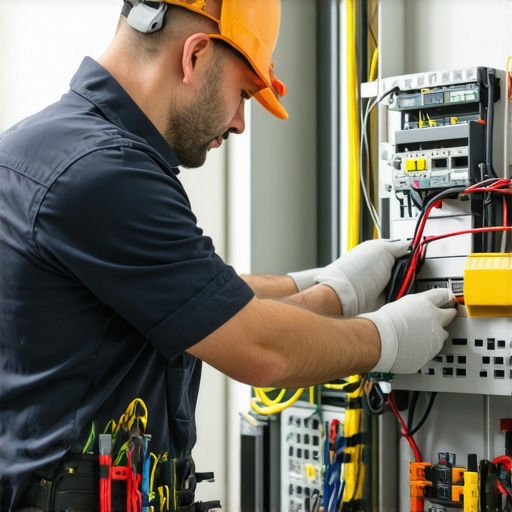
The Sensory Warning of a Failing Grid
I can smell a loose neutral from the driveway. It’s a sharp, metallic tang—ozone mixed with the sweet, sickening scent of melting PVC. When I walk into a home built between 1960 and 1980, I don’t just look at the walls; I listen for the sizzle of a Zinsco bus bar fighting for its life. My journeyman used to smack my hand if I stripped a wire with a knife. ‘You nick the copper, you create a hot spot,’ he’d scream. He was right. That microscopic notch in the conductor reduces the cross-sectional area, increasing resistance at that exact point. Resistance generates heat. Heat causes the copper to expand, then contract when the load drops, eventually loosening the terminal screw. By the time I get there with my Tick Tracer, the wire is brittle, the insulation is charred, and the homeowner is lucky they aren’t standing in a pile of ash.
The Load Calculation Crisis: Blueprint for 2026
The electrical demands of 2026 are not the demands of the 1970s. We are hitting a wall where the physical infrastructure of mid-century homes simply cannot handle the amperage required for modern life. When you attempt a level 2 EV charger installation on a 100-amp service that’s already carrying an electric range and a central AC, you aren’t just ‘adding a circuit’; you’re redlining an engine.
“The total load shall not exceed the rating of the branch circuit, and for continuous loads, the branch-circuit rating shall be at least 125 percent of the continuous load.” – NEC 210.23
This is where the math bites back. A Level 2 charger is a continuous load. It runs for hours at maximum capacity. If your journeyman doesn’t perform a load calculation before the rough-in, you’re asking for a thermal event. We are seeing service masts leaning under the weight of heat-stressed conductors and meter cans where the Monkey Shit (duct seal) has dried out, allowing water to track down the service entrance cable and rot the main lugs from the inside out.
Component Zooming: The Physics of Cold Creep and Arcing
In mid-century homes, we often face the ghost of aluminum wiring. The physics of failure here is Cold Creep. Aluminum expands at a much higher rate than the brass or steel screws in a standard receptacle. Over years of thermal cycling, the wire literally pushes itself out from under the screw. This creates a gap. Once you have a gap, you have an arc. An arc is a plasma bridge that can reach temperatures exceeding 10,000 degrees Fahrenheit. This is why arc-fault circuit interrupter (AFCI) protection is non-negotiable for 2026 safety standards. When we perform permit pulling services, we ensure the system is brought up to current code, not just ‘grandfathered’ into a potential disaster. This includes fire alarm system install protocols that require interconnectivity—if the smoke detector in the basement senses a fire, every alarm in the house must scream. We don’t play games with smoke detector installation because, by the time you smell the smoke, the Romex in your attic has already lost its integrity.
The Critical Infrastructure: From EV Chargers to PA Systems
Modernization requires a Certified Journeyman who understands the nuances of complex systems. Take a standby generator install. It’s not just about bolting a motor to a pad. It’s about the Widow Maker—the lethal backfeeding of electricity into the utility lines. Without a properly installed transfer switch that breaks the connection to the grid before engaging the generator, you risk killing the lineman trying to restore your power. Similarly, PA system installation in high-end homes or smart lighting installation requires specialized shielding to prevent electromagnetic interference (EMI). If you run your speaker wire or data lines too close to your home run power lines without proper 12-inch spacing or 90-degree crossings, you’ll get a 60-cycle hum that no software can fix. Even ‘simple’ tasks like chandelier installation or ceiling fan installation require forensic scrutiny. I’ve seen 50-pound fixtures hung from plastic ‘nail-on’ boxes rated for 10 pounds. One day, gravity wins, and the only thing holding that fixture up is the 14-gauge copper wire—until it isn’t.
Seasonal Loads and Aesthetic Risks
We even see issues during the holidays. Christmas light services often lead to homeowners daisy-chaining seventeen strings of lights into a single exterior outlet.
“Aluminum wire connections can overheat and cause a fire without tripping the circuit breaker.” – CPSC Safety Alert 516
While that alert focuses on aluminum, the principle of terminal overheating applies to overloaded copper circuits as well. When I use my Wiggy to test these circuits, I often find voltage drops that indicate the wire is struggling. Every volt dropped across a high-resistance connection is converted directly into heat inside your walls. This is why hiring a pro for permit pulling services is vital; it forces a second pair of eyes—the inspector—to verify that the trim-out is tight and the torque settings on the breakers meet the manufacturer’s specifications. Don’t let a handyman ‘nick’ your safety. Use dikes to cut the power to your old, failing system and start 2026 with a service that’s actually built for the future.