
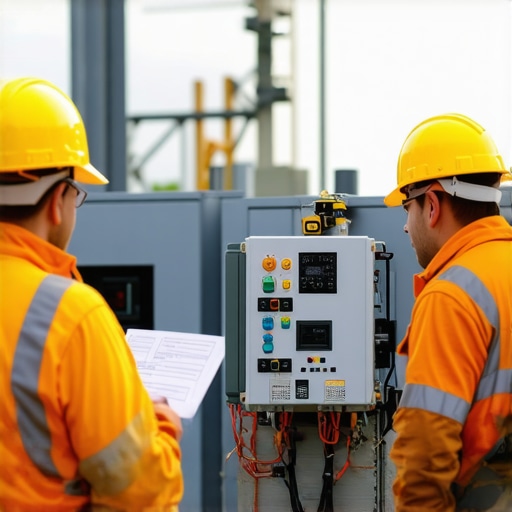
The Invisible Killer: Understanding the Arc Flash Menace
If you have been in this trade as long as I have, you develop a sixth sense for the hum. Not the steady, rhythmic 60Hz drone of a healthy transformer, but the jagged, angry buzz of a loose connection or a deteriorating bus bar. It’s the sound of resistance. And in our world, resistance isn’t just a physical property; it’s a precursor to a catastrophe. As we look toward safety goals for 2026, the industry is finally waking up to the fact that an electrician isn’t just a guy with a pair of dikes and some electrical tape. We are forensic analysts of high-energy environments where a single mistake can turn copper into a plasma cloud reaching 35,000 degrees Fahrenheit.
My first journeyman, a grizzled guy named Mac who smelled like stale coffee and burnt insulation, used to smack my hand if I even looked at a live panel without my ‘Widow Maker’—that non-contact voltage tester—pinned to my pocket. ‘You nick the copper, you create a hot spot,’ he’d growl while watching me strip wire. He wasn’t just being a cranky old-timer. He understood that at the molecular level, a nicked conductor reduces the cross-sectional area, increasing the current density in that specific spot. That localized heat leads to thermal cycling, which further degrades the metal, eventually leading to a failure that can trigger a catastrophic arc. He taught me that electricity doesn’t forgive, and it certainly doesn’t forget a bad installation.
“Aluminum wire connections can overheat and cause a fire without tripping the circuit breaker.” – CPSC Safety Alert 516
The Forensic Breakdown: Why Systems Fail
When we talk about stopping work injuries, we have to perform an autopsy on the failure points before they explode. Take a standard smart meter installation. To the uninitiated, it’s a simple swap. To a forensic inspector, it’s a high-risk operation. If the tension in the meter socket jaws has weakened over thirty years of heat and cold, the new meter won’t seat properly. That creates a high-resistance bridge. When the HVAC kicks on and the current spikes, that bridge starts to glow. In an industrial setting, this isn’t just a melted plastic housing; it’s the trigger for an arc flash. An arc flash study calculates the potential incident energy at these points, dictating what level of PPE an electrician must wear to survive the day.
We also have to look at the grounding electrode install. I’ve seen ‘professionals’ drive a single rod into dry, sandy soil and call it a day. That’s not a ground; it’s a prayer. Without a low-impedance path back to the source, a fault has nowhere to go. This is especially critical for pool pump electrical systems. Water and stray voltage are a lethal combination. If your bonding grid isn’t solid, that pump motor frame becomes a hot surface waiting for a swimmer to complete the circuit. We use a ‘Wiggy’—a solenoid voltmeter—to check these systems because digital meters can sometimes give you ghost readings that lead to a false sense of security.
The Engineering of Prevention: Arc Flash Studies
An arc flash study isn’t just a binder that sits on a facility manager’s shelf. It is a live document that maps the ‘Flash Protection Boundary.’ This is the distance at which an unprotected person would receive second-degree burns. By 2026, we are pushing for every commercial facility to have updated labeling that reflects actual load calculations, not just guesses. This includes parking lot lighting and the massive feeders that supply them. I’ve seen 480V lines for stadium-style lighting that were so corroded inside the base that the ‘Monkey Shit’ (duct seal) had turned into a brittle rock, allowing moisture to bridge the phases. This is why drone light inspections are becoming a standard part of our forensic toolkit. We can use thermal imaging on a drone to spot a hot ballast or a failing termination forty feet in the air without putting a man in a bucket truck.
“Arc flash hazards shall be analyzed before a person is exposed to the electrical hazards.” – NFPA 70E Standard for Electrical Safety in the Workplace
The Component Zoom: Physics of the Failure
Let’s talk about the physics of a failure in something as seemingly simple as kitchen range hood wiring or whole house fan wiring. People think ‘it’s just 120 volts.’ But a loose neutral in a multi-wire branch circuit can send 208 or 240 volts through your sensitive electronics, including that fancy new range hood. In the trade, we call this ‘losing the neutral.’ When that happens, the voltage balances itself across the loads, often frying whatever is plugged in. If the ‘Rough-in’ was done by a hack who didn’t understand the importance of torque, the vibrations from a whole-house fan can loosen the wire nuts over time. This is where ‘Cold Creep’ comes in—the tendency of metal to slowly move or deform under the influence of mechanical stresses and thermal expansion. If you don’t use the right connectors, especially when dealing with older aluminum branch circuits, you are essentially building a slow-motion fuse in your attic.
The same logic applies to network cable installation and CAT6 cabling services. Some ‘low-voltage guys’ think they can zip-tie their data lines to the outside of a high-voltage conduit. That’s a violation of the ‘Home Run’ principle. Electromagnetic interference (EMI) is the least of your worries. If that high-voltage line has an insulation failure and the conduit isn’t properly bonded, you can energize the entire data rack. I’ve seen routers literally melt because a surge hopped from a 277V lighting circuit onto a CAT6 line that was lazily draped across it.
The Solution: A Master’s Approach to 2026 Safety
To stop the injuries, we have to stop the shortcuts. A professional arc flash study involves measuring every foot of wire, every breaker’s trip curve, and every transformer’s impedance. We don’t just look at the ‘Trim-out’—the pretty finished plates and switches. We look at the guts. We look for signs of ‘arcing and sparking’—that tell-tale pitting on the bus bars that says a breaker hasn’t been seated correctly for a decade. We ensure that the grounding electrode install meets the soil resistivity requirements of the local geography. We don’t just pull Romex; we engineer paths of safety. If you want to sleep at night, you don’t hire a handyman to touch your panel. You hire someone who understands that the electricity sitting in those wires is a coiled spring, waiting for a point of resistance to turn into a bomb. By 2026, the goal is zero incidents. That only happens when we treat every lug with the same respect as a loaded gun and every arc flash study as a survival manual.