
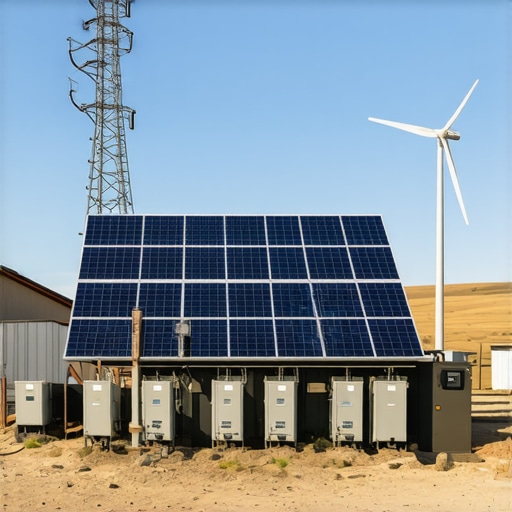
The Smell of a Time Bomb: Why Your 2026 Microgrid is a Fire Risk
I can usually smell a bad installation before I even pull my Wiggy out of the truck. It is that cloying, sickly sweet scent of scorched PVC insulation and the ozone tang of a micro-arc. People in 2026 are obsessed with the ‘independence’ of off-grid microgrids, but they are trying to bolt space-age silicon carbide inverters onto 1970s garbage. If you think your ‘renovated’ home is ready for a high-output battery integration, you are likely sitting on a thermal event waiting for a catalyst. I have spent 35 years looking at what happens when high-voltage DC meets a loose neutral, and it is never pretty.
The Old Timer’s Lesson: The Nick That Kills
My journeyman used to smack my hand with a pair of dikes if he saw me stripping a wire with a pocket knife. ‘You nick the copper, you create a hot spot,’ he’d scream. He was right. In a modern microgrid setup, where current flow is constant and heavy, that microscopic nick becomes a point of extreme resistance. Under a remote electrical diagnostics sweep, that nick shows up as a white-hot sun on the infrared camera. Most ‘electricians’ today treat smart home wiring like it is plug-and-play USB cable. It is not. It is a thermodynamic load profile that your house was never engineered to handle.
1. The Fatal Flaw: Fuse Box to Breaker Conversion and Bus Bar Integrity
The first fix for any 2026 microgrid integration is the fuse box to breaker conversion, but not just any swap. I see guys pulling out old glass fuses and slapping in a cheap 100-amp panel they bought at a big-box store. The physics of cold creep in these cheap bus bars is a nightmare. When you are cycling power from a solar array to a battery bank, the thermal expansion and contraction cycles are brutal. If you do not torque those lugs to the exact inch-pound spec—not ‘gut-tight,’ but spec-tight—the metal will eventually deform. Once it deforms, you get air gaps. Air gaps lead to arcing. Arcing leads to a 911 call.
“Aluminum wire connections can overheat and cause a fire without tripping the circuit breaker.” – CPSC Safety Alert 516
If your home was built between 1960 and 1980, you likely have aluminum branch circuits. Integrating a microgrid without a total home rewiring service is suicide. Aluminum has a higher coefficient of thermal expansion than copper. Every time your home theater wiring or HVAC kicks on, that wire expands and pushes against the screw. When it cools, it doesn’t snap back. It leaves a gap. We call it ‘cold creep,’ and it is the primary reason why mid-century homes melt down when faced with the continuous duty cycles of a 2026 off-grid power plant.
2. The Grounding Myth: Why Your Portable Generator Hookup is Floating
I’ve walked into too many ‘off-grid’ setups where the portable generator hookup is a death trap. People forget about the bonded neutral. If your generator is bonded and your house panel is also bonded, you’ve just created a ground loop that will fry your sensitive smart home wiring faster than a lightning strike. You need a remote electrical diagnostics check to ensure your grounding electrode system is actually doing its job. I’ve seen 8-foot ground rods driven into literal sand where the resistance was over 100 ohms. That’s not a ground; it’s a decorative copper pole.
3. Permanent Holiday Lighting and the Phantom Load Problem
In 2026, everyone wants permanent holiday lighting integrated into their smart home grid. These systems are often installed by low-voltage ‘techs’ who wouldn’t know a home run from a hole in the ground. They tap into existing circuits, ignoring the total load calculation. When that microgrid switches from the main battery to the backup, the surge can cause an inductive kickback. This ruins the drivers in your LED system and creates a parasitic drain that can kill your off-grid storage in 48 hours. If you aren’t using a tick tracer to verify where those wires are buried, you are just guessing.
“All electrical equipment shall be installed in a neat and workmanlike manner.” – NEC Article 110.12
That ‘workmanlike manner’ is not just about aesthetics. It’s about airflow. I’ve found phone line installation cables tangled with high-voltage Romex in emergency exit lighting conduits. That is a violation of basic separation of circuits. When you have high-frequency noise from an inverter bleeding into your data lines, your ‘smart home’ becomes a ‘dumb fire hazard.’
4. The Invisible Killer: Arcing in the Home Theater Wiring
Your home theater wiring is often the last place people look for fire hazards, but it’s a forensic investigator’s goldmine. People run 120V power through walls without smurf tube or proper protection, right next to unshielded speaker wire. In a microgrid environment, the inverter’s total harmonic distortion (THD) can cause those wires to vibrate at a microscopic level. This is mechanical fatigue. Eventually, the insulation rubs through, and you get a high-impedance fault. A standard breaker won’t trip. It just sits there and cooks the studs inside your wall until the smoke detector finally wakes you up.
5. Mandatory Home Rewiring Services: The Only Real Fix
If you are serious about 2026 microgrid integration, you stop looking for ‘fixes’ and start looking at a home rewiring service. You need a dedicated electrician who understands Forensic Infrastructure Analysis. This means pulling out the old cloth-covered wire, dumping the Zinsco or Federal Pacific panels into the scrap heap, and running home runs for every major appliance. You need emergency exit lighting that is on a separate, supervised circuit. You need monkey shit (duct seal) in every exterior conduit to prevent moisture from wicking into your main lugs. Electricity is a lazy, angry beast. It wants to find the shortest path to ground, and it doesn’t care if that path is through your floorboards or your chest cavity. Stop treating it like a DIY project and start treating it like the dangerous physics experiment it is.