
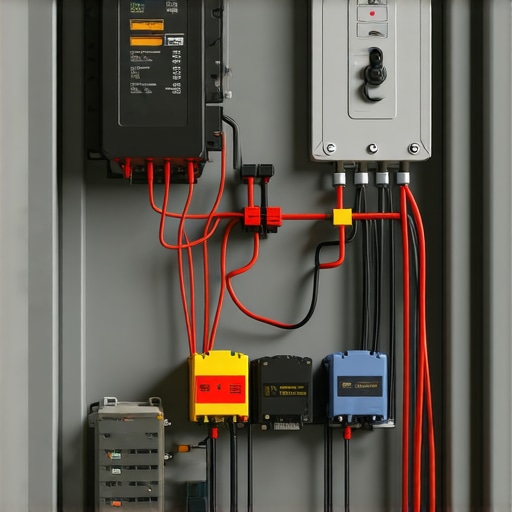
The Deceptive Silence of the Backup Battery
You’re standing in your garage, looking at a sleek, matte-finished battery mounted to the wall. It’s 2026, and the grid has been down for forty-eight hours. The neighbors are in the dark, but your lights are on. You feel smug. Then, you smell it. It’s not smoke—not yet. It’s that cloyingly sweet, ozone-heavy scent of overheating PVC insulation. You pull out your Wiggy and realize the voltage at your sub-panel is sagging like an old clothesline. You’ve fallen into the trap of thinking high-tech hardware fixes low-quality rough-in work.
My old journeyman used to smack my hand if I stripped a wire with a knife. ‘You nick the copper, you create a hot spot,’ he’d scream. He was right. Back then, we were just worried about a 15-amp lighting circuit. Today, with microgrid integration and whole-home battery backups, that tiny nick is a thermal bomb. When you’re pulling 40 or 60 amps of continuous DC-to-AC inverted power for seven days straight, resistance isn’t just a number on a multimeter; it’s a fire starter.
“Aluminum wire connections can overheat and cause a fire without tripping the circuit breaker.” – CPSC Safety Alert 516
The Physics of the Constant Load: Why Your 1990s Wiring is Crying
Most residential wiring was never designed for 100% duty cycles. We used to size for intermittent loads—the toaster runs for three minutes, the AC kicks on for twenty. But a week-long outage changes the math. Your home run conductors are now under constant stress. This is where Ohm’s Law gets mean. Resistance (R) generates heat (H) proportional to the square of the current (I). If your main disconnect services weren’t torqued to exact inch-pound specifications with a calibrated wrench, that connection point is slowly vibrating itself to death through thermal expansion and contraction.
Component Zooming: The Metallurgy of Failure
Let’s talk about the lugs. In a standard commercial electrical services environment, we see this constantly. When a battery system discharges, the terminal lugs heat up. The copper wire expands. If the lug is steel or a different alloy, it expands at a different rate. This is ‘Cold Creep.’ Over a week-long outage, those cycles happen hundreds of times. Eventually, the connection loosens. Now you have an air gap. Air is an insulator until the voltage gets high enough to jump it. Then you have an arc. An arc is hotter than the surface of the sun. Your AI fault detection might catch the signature of that arc, but by then, your expensive inverter’s motherboard is already toast.
Trenching Electrical Conduit and the Outdoor Battery Factor
If your backup system is housed in an external enclosure, the trenching electrical conduit becomes a critical failure point. I’ve seen 1-inch PVC shattered by frost heave because some ‘pro’ didn’t dig past the frost line. When the conduit snaps, it shears the Romex or THHN inside. If you’re lucky, it shorts and trips the breaker. If you’re unlucky, it creates a high-resistance ground fault that cooks the soil until the insulation melts. We use monkey shit (duct seal) at every entrance point for a reason—to keep the moisture out that turns your copper green with oxidation. Green copper is resistive copper. Resistive copper is a heater you didn’t ask for.
“The grounding of the system shall be installed in a manner that creates a low-impedance path to ground.” – NEC 250.4
Swimming Pool Bonding and the Microgrid Conflict
One thing people forget when they go ‘off-grid’ during an outage is swimming pool bonding. Your battery backup creates its own local ground-neutral bond when it’s in island mode. If your pool’s bonding grid isn’t perfectly integrated into the house’s main grounding electrode system, you can end up with ‘stray voltage’ in the water. I’ve been to jobs where the homeowner got a 50-volt tingle while touching the ladder during a backup test. That’s a widow maker scenario. In 2026, your backup isn’t just an appliance; it’s a utility company in your basement, and it demands the same rigorous bonding standards as a power plant.
The Solution: Beyond the Battery
Don’t just buy a battery; buy a system. This means power factor correction to ensure your well pump and fridge motors aren’t wasting energy as heat. It means a warehouse lighting retrofit mentality for your home—swapping high-draw loads for efficient ones before the outage hits. And it means a priority service membership with a firm that actually knows how to use a torque wrench, not just a tick tracer. We offer a lifetime workmanship guarantee because we don’t just ‘wire it up’—we forensic-proof the installation. We check the lugs, we coat the terminals in anti-oxidant compound, and we ensure every dikes-cut is clean and every trim-out is tight.