
The Smell of Burning Phenolic Resin
You’re parked on a beautiful ridge, the sun is dipping below the horizon, and you’ve just turned on the induction cooktop for a well-earned dinner. Then you smell it. It isn’t the forest; it’s that sharp, acrid stench of burning plastic and ozone. In my 35 years as a licensed master electrician and forensic inspector, I’ve smelled that scent more times than I care to count. Usually, it’s followed by the sound of a plastic housing warping or the frantic search for a fire extinguisher. Most van-lifers treat their electrical system like a black box—something that just works until it doesn’t. But a van isn’t a house; it’s a vibrating torture chamber for copper and steel. When I conduct electrical inspections on these mobile rigs, I see the same terrifying shortcuts: undersized wire, loose lugs, and panels that look like they were wired by a caffeinated squirrel. If you want to survive the 2026 van life circuit without becoming a cautionary tale in a forensic report, you need to understand that your electrical panel is the heart of your home—and right now, most hearts are failing.
The Old Timer’s Lesson: The Physics of the Loose Screw
My journeyman, a guy we called ‘Big Red’ who had been pulling wire since the Eisenhower administration, used to smack my hand with a pair of dikes if I ever tried to reuse a crimp connector. ‘You’re not just making a connection, kid,’ he’d bark. ‘You’re building a bridge for a stampede of angry electrons. You make that bridge weak, they’ll burn the whole town down just to cross it.’ He was right. In a van, that ‘town’ is your bed, your kitchen, and your escape plan. He taught me that electricity isn’t just about flow; it’s about resistance and heat. In a stationary setting, like industrial motor controls or warehouse lighting retrofit projects, we worry about vibration, but it’s nothing compared to the 24/7 rattling of a Sprinter van on a washboard road. Every bump is a mechanical stressor trying to back out your terminal screws. Once a screw loses its torque, you get micro-arcing. Each arc creates cupric oxide, a high-resistance layer that turns your breaker into a space heater. By the time your Tick Tracer goes off, the damage is already done.
“All splices and joints and the free ends of conductors shall be covered with an insulation equivalent to that of the conductors or with an insulating device identified for the purpose.” — National Electrical Code (NEC) 110.14(B)
1. Transitioning to Solid-State Digital Switching
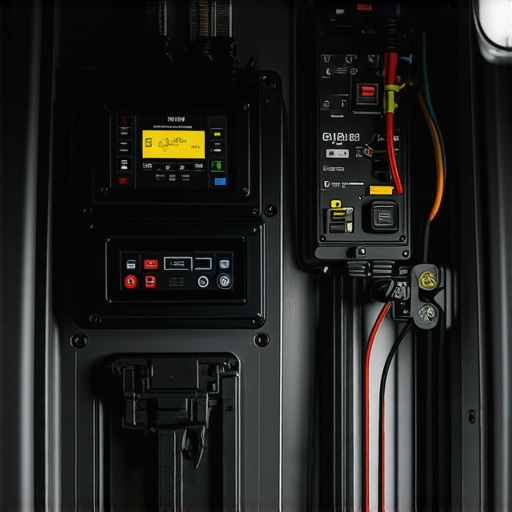
The first major upgrade for 2026 isn’t just a better fuse box; it’s the total elimination of mechanical fuses. Physical fuses are a 19th-century solution for a 21st-century problem. In the mobile environment, the contact points of a standard blade fuse are prone to oxidation and ‘Cold Creep.’ As temperature fluctuates from the desert heat to mountain frost, the metal expands and contracts at different rates. Digital switching systems, similar to what you’d find in high-end industrial motor controls, use MOSFETs to monitor current. They don’t just ‘pop’ like a fuse; they detect a fault in milliseconds, often before the wire even gets warm. This is the same level of precision I’d expect in a sign lighting installation where moisture is a constant threat. These panels allow you to program the ‘trip’ threshold to the milliamp, providing a level of safety that a standard Romex-based residential panel simply cannot match.
2. High-Amperage DC-DC Charging Infrastructure
Most van owners try to pull too much power through their alternator without a proper ‘Home Run’ to the battery bank. I’ve seen 4AWG wire melted into the chassis because someone thought they could skimp on the charging circuit. For 2026, the standard is shifting toward 48V systems, which reduces the required amperage and, consequently, the heat. When I’m giving free electrical estimates for van upgrades, the first thing I look at is the DC-DC charger. You need a dedicated, fused line that is vibration-dampened. Think of it like hot tub wiring services—you wouldn’t run a 50-amp tub on a doorbell wire. The same logic applies here. If the insulation on your primary charge wire nicks against the frame, you don’t just get a spark; you get a dead short that can weld your electric gate opener or anything else metallic to the frame. Using high-strand ‘Class K’ copper is non-negotiable for these runs to ensure the wire can handle the constant flexing without work-hardening and snapping.
3. The Integrated AFCI/GFCI Protection for DC Circuits
We’ve had Arc-Fault Circuit Interrupters (AFCI) in homes for years to prevent fires from frayed cords. In 2026, we are finally seeing this technology integrated into DC panels for campers. This is critical because a DC arc won’t always trip a standard breaker. A DC arc can be ‘stable,’ meaning it will just sit there and sizzle, melting everything around it while only drawing 15 amps on a 20-amp circuit. This is why you can’t just call a 24 hour emergency electrician when you’re 50 miles into the backcountry; the fire will be over before they answer the phone. These new panels monitor the ‘noise’ on the line—the specific frequency of a sparking wire—and shut down the circuit instantly. It’s the same technology used to protect parking lot lighting from wind-induced wire fatigue, adapted for the rigors of van life.
“A loosened connection can lead to overheating, resulting in a fire that may spread to surrounding materials.” — CPSC Safety Warning
4. Smart Terminal Blocks and Thermal Monitoring
The ‘Forensic Inspector’ in me loves this upgrade. We are now seeing distribution panels equipped with thermal sensors on the main busbars. If a lug starts to get hot due to a loose connection or corrosion, the panel sends an alert to your phone before the plastic starts to smoke. I use a Wiggy to check voltage drops in the field, but having a permanent, real-time monitor is a literal life-saver. This is especially important for the ‘rough-in‘ phase of a build. People hide their junction boxes behind beautiful tongue-and-groove cedar walls. If that connection fails, you have to tear the whole van apart to find it. Smart terminals tell you exactly where the resistance is building. It’s like having a licensed master electrician living in your cabinet, constantly checking the torque on every screw.
5. Bi-Directional High-Voltage DC-DC Converters
As we move toward 2026, the integration of the van’s starter battery and the house battery bank is becoming more complex. Old isolator solenoids (the ‘Widow Maker‘ of the van world because they always fail at the worst time) are being replaced by bi-directional converters. These units manage the load perfectly, ensuring that your alternator isn’t overworked and your house batteries are charged at the exact voltage profile they require. It’s a sophisticated piece of gear, closer to a warehouse lighting retrofit control system than a simple relay. When you’re dealing with Lithium Iron Phosphate (LiFePO4) batteries, the charging curve is everything. One wrong setting and you’ve just turned a $3,000 battery bank into an expensive paperweight. I always recommend using ‘Monkey Shit‘ (duct seal) to seal any exterior penetrations where these high-current wires enter the cabin to prevent moisture from starting the corrosion cycle on these expensive terminals.
The Final Forensic Verdict
Van life isn’t just about the ‘Gram and the views; it’s about survival in a small, flammable box. If you’re still using a cheap plastic fuse block from a 1980s trailer, you’re living on borrowed time. Electricity isn’t a hobby, and a van isn’t a static environment. You need a panel that respects the laws of physics. Don’t wait until the smoke is rolling out from under your seat to think about your trim-out. Get a real licensed master electrician to look at your load calculations. Ensure your grounding is bonded to the chassis correctly to avoid ‘hot skin’ syndrome. Your electrical system should be boring. It should be silent, cool, and invisible. If it’s giving you excitement, you’ve done something wrong. Make the investment in 2026-grade hardware now, or you might find yourself needing a 24 hour emergency electrician who is 300 miles away while your dream van goes up in a cloud of lithium smoke.