
The Era of the $300 Truck Roll
In 2026, the price of a service van turning into your driveway has reached a fever pitch. Between insurance premiums for high-risk forensic inspections and the skyrocketing cost of specialized diagnostic tools, the ‘call-out fee’ is no longer just a gas surcharge—it is a barrier to entry. If you are calling a pro for garage wiring services or a flickering pendant light hanging in the kitchen, you are likely paying for their windshield time before they even pull a Tick Tracer out of their pocket. But here is the truth: half of the hazards I find during a forensic audit could have been identified by the homeowner using basic remote diagnostic logic. My old journeyman used to smack my hand if I stripped a wire with a knife. ‘You nick that copper, you create a hot spot,’ he’d scream. He was right. That microscopic notch reduces the cross-sectional area of the conductor, increasing resistance. Resistance creates heat. Heat creates fire. This philosophy is the bedrock of remote diagnostics—identifying the physics of failure before the smoke starts.
The Physics of the ‘Heavy-Up’: Why Your 100-Amp Panel is Screaming
Most mid-century homes built between 1960 and 1980 were never designed for an EV charger installation or a high-draw workshop electrical setup. We are talking about infrastructure designed for a few incandescent bulbs and a toaster. When you add a Level 2 charger, you are pulling a continuous load that can push a legacy bus bar to its thermal limit. This is where Cold Creep becomes your worst enemy. Aluminum wiring, common in that era, has a different coefficient of thermal expansion than the steel lugs in your panel. Every time you charge that car, the wire heats up and expands. When it cools, it contracts. Over time, the wire literally ‘creeps’ out from under the screw. This creates a loose connection with high resistance.
“Aluminum wire connections can overheat and cause a fire without tripping the circuit breaker.” – CPSC Safety Alert 516
If you want to avoid a massive bill, look for the ‘ghosting’ on your panel cover or a faint smell of ozone. That is the smell of atoms jumping a gap they shouldn’t be jumping.
1. Smart Home Monitoring: The Digital Forensic Inspector
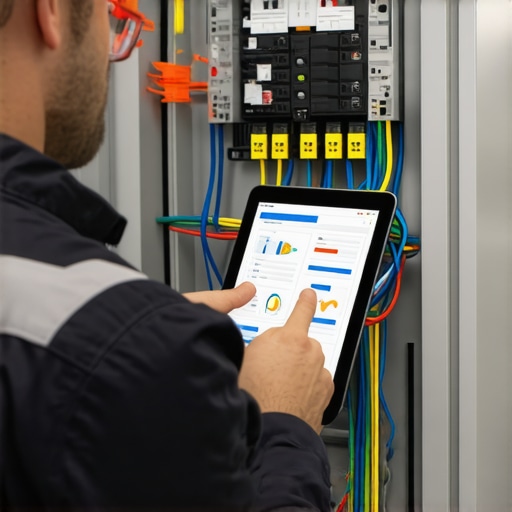
The first way to dodge those 2026 fees is through smart home wiring that includes integrated energy monitors. Modern systems can detect the specific ‘signature’ of a failing compressor or an arcing camper electrical panel plugged into the side of the house. By analyzing the sine wave of your electrical current, these devices can tell if a home run has a loose neutral. If your lights flicker when the vacuum turns on, you don’t need a service call yet; you need to check the balance of your phases. A remote technician can often view your power quality data via the cloud and tell you exactly which circuit is failing, saving hours of ‘hunt and peck’ labor at $200 an hour.
2. Visual Forensic Audits of the Overhead Service Drop
Before you pay for a trenching electrical conduit project or a fire alarm system install, go outside and look up. The overhead service drop is the most neglected part of the residential system. I’ve seen service entrance cables where the weather-head has cracked, allowing water to siphon down the inside of the jacket directly into the main lugs. This causes ‘white rust’—aluminum oxide—which is an insulator. If you see the outer fabric of your service cable fraying or ‘alligatoring,’ you are looking at a future house fire. Taking a high-resolution photo and sending it to an inspector for a virtual consult can confirm if you need a ‘heavy-up’ or just a new weather-head. This prevents the emergency weekend rate when the lights finally go out during a storm.
3. The Low-Voltage Trap: Network and Signal Integrity
I often get called for network cable installation issues where the homeowner thinks the ISP is at fault. In reality, it is often inductive reactance. When some ‘handyman’ runs Cat6 parallel to a high-voltage Romex line for thirty feet, the 60Hz electromagnetic field from the power line bleeds into the data stream. This is ‘noise.’ You don’t need a tech to come out and pull new wire if you can identify the crossover points. Use a Wiggy or a simple induction wand to see where your power lines are. If your data racks are hummed out, check the grounding. A ‘bootleg ground’—where someone tied the neutral to the ground screw on a receptacle—will wreak havoc on sensitive electronics and won’t show up on a cheap plug-tester. You need to verify the path back to the dirt.
“The grounding electrode conductor shall be installed in one continuous length without splice or joint.” – NEC 250.64(C)
When to Put Down the Dikes and Call the Pros
There is a line between ‘diagnosing’ and ‘dying.’ If you open a junction box and find ‘monkey shit’ (duct seal) oozing out of a conduit, or if you see a bus bar that looks like it was charred on a charcoal grill, stop. Remote diagnostics are meant to identify the scope of work, not to bypass code-compliant repairs. Whether you are prepping for a workshop electrical setup or just trying to keep the fire alarm system install from chirping at 3 AM, understanding the thermal dynamics of your home is the only way to keep your wallet fat and your roof over your head in 2026. Torque your lugs, watch for oxidation, and never, ever trust a flipper’s ‘renovated’ kitchen until you’ve seen what’s behind the backsplash with a Tick Tracer.